
Why SLA?
Finest details
Structures and lettering that FDM cannot reproduce.
Smooth surfaces
Barely visible layers, ideal for visual samples.
Precise fits
Tight tolerances for precision mechanics.
Special resins
Tough, flexible, transparent or heat-resistant.
SLA at ProtyLabs
Guide values. What is realistic for your part, we clarify in the quote.
| Feature | Value |
|---|---|
| Processes | Stereolithography (resin printing, MSLA) |
| Materials | engineering resins from Formlabs, e.g. Rigid 4000 |
| Surface | smooth, further finished on request |
| Quantity | Single part to small series |
Materials for SLA
Standard resins
For visual samples and design models with a very smooth surface.
Tough resins
More impact-resistant and durable for functional prototypes.
Flexible, transparent and heat-resistant resins
For seals, viewing windows or parts under temperature.
What we use it for
How to make your part better
When another process is a better fit
FDM
When the part is large and the surface is secondary.
SLS
When the part has to be tough and durable over the long term.
SLM (metal)
When the part has to withstand heat and high loads.
What is SLA – and when is it the best choice?
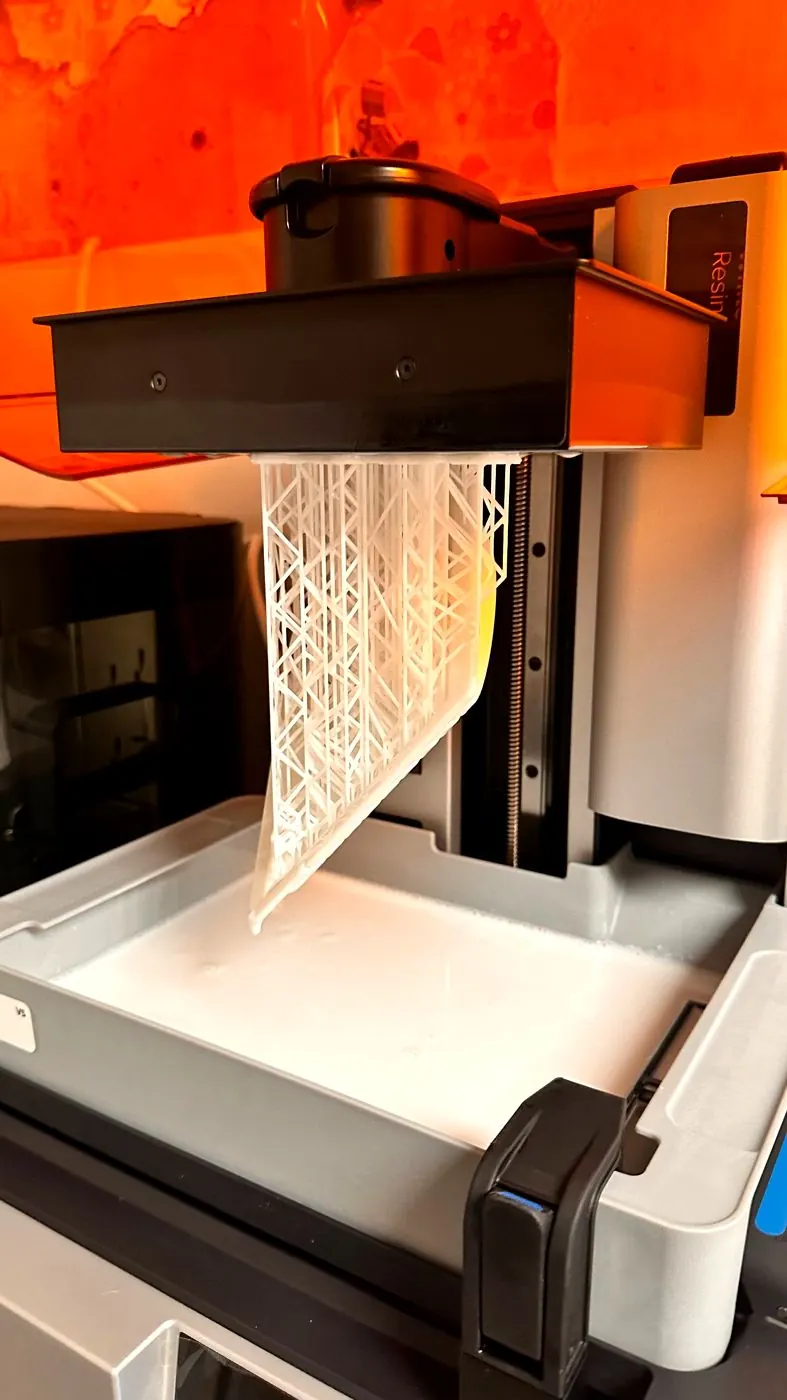
In stereolithography, light cures liquid resin layer by layer. The result is very fine details, smooth surfaces with barely visible layers and tight tolerances. SLA is the first choice for visual and design samples, precision mechanics, accurate fits, casting patterns and small precision parts.
Depending on the resin, the part becomes hard and stiff (Rigid 4000), tough (Tough 1500/2000), flexible (80A, 50A), heat-resistant (High Temp) or transparent (Clear). After printing, SLA parts are cleaned and post-cured with UV light – that is part of our service. For large, solid parts or continuous outdoor loads, FDM or SLS is usually better.
Design guide values
| Walls and holes | over 1 mm |
|---|---|
| Hollow bodies | drain holes larger than 2 mm |
| Overhangs | supports almost always needed |
| Threads | fine threads possible, inserts are better |
| Post-treatment | cleaning and UV post-curing included |
Guide values, depending on the resin.
FAQ about SLA
Are SLA parts brittle?
Standard resins are rather hard. For loaded parts we use tough or flexible resins.
Are SLA parts UV-resistant?
Only to a limited extent. For permanent outdoor use we advise you on alternatives.
Can SLA parts be painted?
Yes, the smooth surface is well suited for painting.
Want to turn your idea into a finished part?
Send us CAD data, a photo, a sketch or the original part. We check feasibility, process and material and get back to you with an assessment and a quote.