
Why 3D printing for metal & lightweight parts?
Less weight
Material only where forces act.
Free forms
Organic structures and internal channels.
Fewer parts
Assemblies become a single component.
Design included
Topology optimisation from one source.
What we make for you
What suits what?
| Component | Processes | Materials |
|---|---|---|
| Corrosion-resistant parts | SLM (metal) | Stainless steel 316L |
| Light & thermally conductive | SLM (metal) | Aluminium AlSi10Mg |
| Maximum strength at low weight | SLM (metal) | Titanium TC4 |
| Lightweight design in plastic | SLS / MJF | PA12 |
| Stiff plastic lightweight parts | FDM | PA12-CF |
From our production
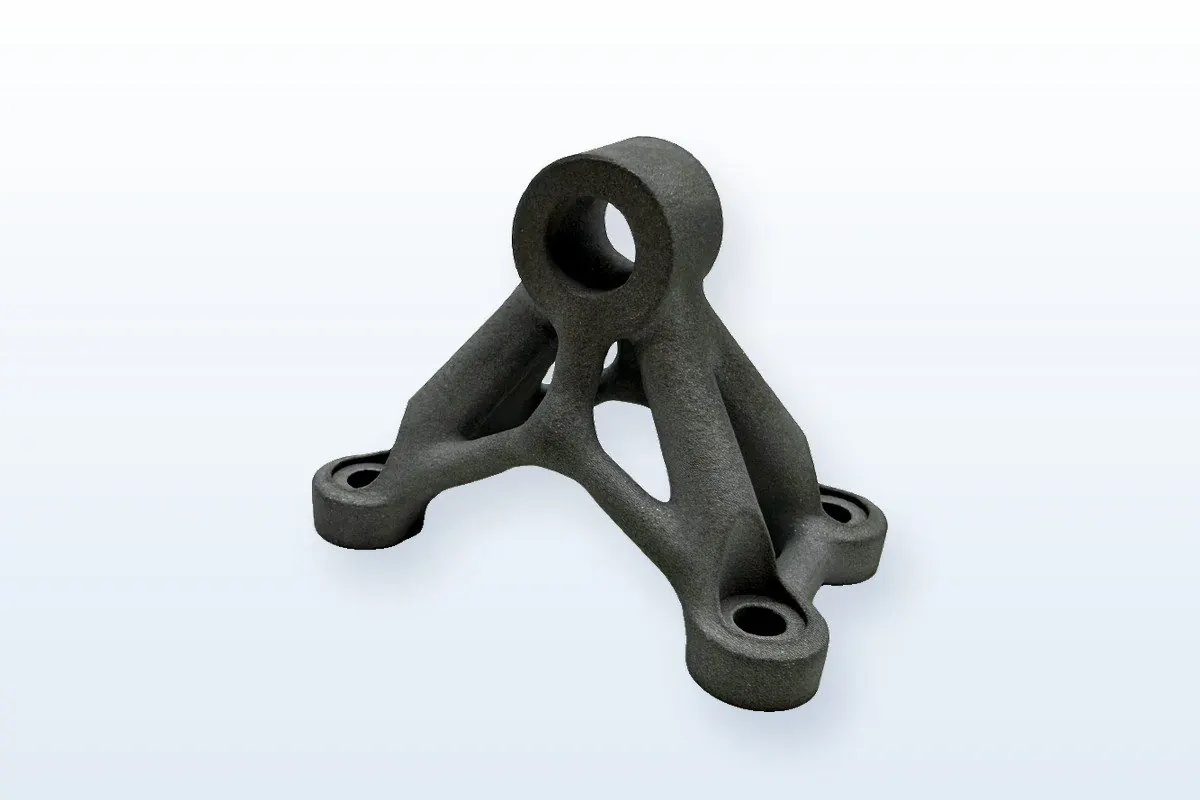
Topology-optimised bracket
Bracket made by SLM (metal), 104 × 68 × 88 mm – lighter than milled, just as strong.
How to get your part
- Step 1
Enquiry
Send a file, photo, sketch or the original part.
- Step 2
Advice & quote
We recommend process and material – quote within 24 h.
- Step 3
Manufacturing
Design or scan if needed, then printing.
- Step 4
Post-processing & delivery
Delivered ready to install, express in 2–3 days.
When is a printed metal part economical?
Honestly calculated: simple prismatic parts are usually cheaper milled, very large series cheaper cast. Metal 3D printing pays off when the shape gets complex – internal channels, organic structures, undercuts – or when several parts can be combined into one. Then complexity costs hardly anything extra in printing, while it gets expensive in milling.
Further advantages: less waste, especially with expensive titanium; less weight reduces energy and wear in operation; full builds lower the unit price. A hybrid is often sensible: print the part and machine the functional surfaces.
Materials (guide values)
| Stainless steel 316L | tensile 600 MPa, elongation 30 % |
|---|---|
| Aluminium AlSi10Mg | tensile 390 MPa, density 2.67 g/cm³ |
| Titanium TC4 | tensile 1160 MPa, 36 HRC |
| Tolerance | ±0.3 mm or ±0.4 % |
| Wall thickness | from 1.5 mm |
Partner data, guide values.
FAQ about metal & lightweight parts
When is SLM (metal) worthwhile?
For complex shapes, lightweight design, internal channels or small quantities. For simple geometries milling is often cheaper – we will tell you honestly.
Do you take care of topology optimisation?
Yes, on request we design and optimise the component for SLM (metal).
Want to turn your idea into a finished part?
Send us CAD data, a photo, a sketch or the original part. We check feasibility, process and material and get back to you with an assessment and a quote.